
Diabetes mellitus represents a significant and growing public health challenge in Sri Lanka, with prevalence estimates indicating that over 20% of adults are affected. Rapid urbanisation, lifestyle transitions, and improved diagnostic practices have contributed to this rising burden. Despite increased awareness of diabetes among patients, adherenc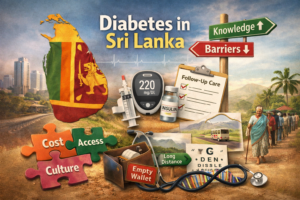 e to follow-up care and long-term management remains suboptimal. This critical review evaluates existing evidence on diabetes-related knowledge and barriers to follow-up care among Sri Lankan adults, while highlighting methodological strengths and limitations in current research.
Evidence suggests that general knowledge of diabetes among Sri Lankan patients is moderate but inconsistent across populations. A study conducted in Colombo reported that approximately 70% of patients demonstrated adequate knowledge regarding diet, exercise, and complications of diabetes, with higher scores associated with increased educational level and longer disease duration (Perera et al., 2013). Similarly, research from Southern Sri Lanka found that 77% of participants had moderate to good knowledge levels; however, a large proportion (88%) expressed negative attitudes towards disease control (Herath et al., 2017). This disconnect between knowledge and attitudes indicates that awareness alone does not translate into effective self-management behaviours.
More recent evidence highlights gaps in practical knowledge, particularly among insulin users. Jayasundara et al. (2025) reported poor adherence to correct insulin self-administration techniques despite clinical exposure, suggesting that experiential learning and reinforcement are insufficient. Many studies assessing knowledge in Sri Lanka utilise structured questionnaires adapted from validated tools such as the Michigan Diabetes Knowledge Test. While these tools are useful for standardised assessment, they may not adequately capture the depth of understanding or behavioural application. For example, patients with good theoretical knowledge may still neglect essential practices such as foot care or regular screening.
A key limitation in current knowledge-based studies is the over-reliance on quantitative scoring systems. While knowledge scores provide measurable outcomes, they fail to explore underlying behavioural drivers. Evidence from Knowledge–Attitude–Practice (KAP) studies suggests that educational interventions can improve knowledge by 20–30%, yet behavioural change remains limited without structured support systems (Herath et al., 2017). Therefore, future studies should integrate validated attitude and practice scales alongside knowledge assessments to provide a more comprehensive understanding of patient behaviour.
In contrast to knowledge deficits, barriers to follow-up care appear to play a more critical role in diabetes management. Financial constraints remain a major obstacle, particularly in Sri Lanka’s mixed public–private healthcare system. Recent data indicate that low income is strongly associated with medication non-adherence, with rates as high as 64% among economically disadvantaged groups (Perera et al., 2026). Even within public healthcare services, indirect costs such as transportation and loss of income contribute significantly to missed appointments.
Geographical and logistical barriers are particularly evident in rural populations. Piyasena et al. (2019) reported that approximately 40% of patients failed to attend diabetic retinopathy screening due to travel distance and accessibility issues. These findings highlight the persistent rural–urban disparity in healthcare access. Additionally, long waiting times and overcrowded clinics further discourage regular follow-up, particularly among working-age adults.
Cultural and social factors also influence diabetes management behaviours. The use of traditional medicine, including Ayurveda, remains prevalent, with approximately 30% of patients incorporating alternative treatments into their care (Sohal et al., 2015). While this reflects cultural beliefs, it may contribute to delayed medical follow-up. Furthermore, social practices such as communal eating and cultural expectations can negatively affect dietary adherence. Gender roles also play a role, with women often facing competing household responsibilities that limit their ability to prioritise clinic visits, despite demonstrating relatively higher knowledge levels (Herath et al., 2017).
Health system-related factors further compound these challenges. Short consultation times, inadequate patient education, lack of structured follow-up systems, and medication stock-outs have been identified as significant barriers. Similar issues have been observed in gestational diabetes care, indicating systemic gaps in chronic disease management (Godevithana et al., 2024). While many studies quantify barriers using Likert-scale assessments, these approaches may not fully capture patient experiences. Qualitative methods, such as in-depth interviews, are essential to understand the contextual and personal factors influencing adherence.
Associations between knowledge, barriers, and adherence have been explored in several studies. Higher levels of education and longer disease duration are consistently associated with improved knowledge, while the presence of complications often increases perceived barriers. Although increased knowledge is linked to modest improvements in adherence (approximately 15%), structural barriers such as cost and access frequently override these benefits (Perera et al., 2026). The rural–urban divide remains significant, with transportation-related barriers reported to be substantially higher in rural settings (Piyasena et al., 2019).
Methodologically, many studies demonstrate strengths such as the inclusion of diverse adult populations and alignment with global frameworks such as the World Health Organization’s non-communicable disease strategy. However, several limitations are evident. Self-reported data may overestimate knowledge and adherence, while cross-sectional designs limit causal inference. Additionally, clinic-based sampling may introduce selection bias, reducing generalisability to the wider population. Adequate sample sizes (e.g., minimum of 384 participants for 5% margin of error) are necessary to ensure statistical reliability, particularly for subgroup analyses.
This review highlights the need for a more integrated approach to diabetes management in Sri Lanka. While improving patient knowledge remains important, addressing structural and systemic barriers is essential for achieving meaningful behavioural change. Interventions such as mobile health reminders, community-based education programmes, transportation support, and culturally sensitive care models may help bridge the gap between knowledge and practice. Compared to other South Asian countries, Sri Lanka demonstrates relatively strong healthcare access but lags behind in the adoption of digital health innovations.
In conclusion, diabetes management in Sri Lanka is influenced by a complex interplay of knowledge, behavioural factors, and systemic barriers. Current evidence suggests that knowledge alone is insufficient to ensure adherence to follow-up care. Future research should adopt mixed-method approaches, validate assessment tools within local contexts, and focus on outcome-based measures such as glycaemic control. Addressing both individual and structural barriers will be essential in improving long-term diabetes outcomes in Sri Lanka.
References
Godevithana, J., et al. (2024). Barriers and facilitators for universal gestational diabetes screening. Scientific Reports. https://doi.org/10.1038/s41598-024-76863-3
Herath, H. M. M., et al. (2017). Knowledge, attitude and practice related to diabetes mellitus among the general public in Southern Sri Lanka. PLOS ONE.
Jayasundara, W. M. S. D., et al. (2025). Knowledge on insulin self-administration, its adherence and associated factors. University of Colombo Archive.
Perera, D. P., et al. (2013). Knowledge of diabetes among type 2 diabetes patients in Sri Lanka. PubMed.
Perera, K. M. T. B., et al. (2026). Medication adherence among adults with type 2 diabetes in Sri Lanka. Sciety (preprint).
Piyasena, M. M. P. N., et al. (2019). Barriers and enablers to uptake of diabetic retinopathy screening. BMC Health Services Research.
Sohal, T., et al. (2015). Barriers and facilitators for type 2 diabetes management in South Asians. PLOS ONE. https://doi.org/10.1371/journal.pone.0136202